FOR BUSINESS ENQUIRIES +91 9742 000 773 +91 9581 000 770
site logo

Uncategorized

Uncategorized

In-House Accounting vs Outsourcing: What Works for Small Businesses in India

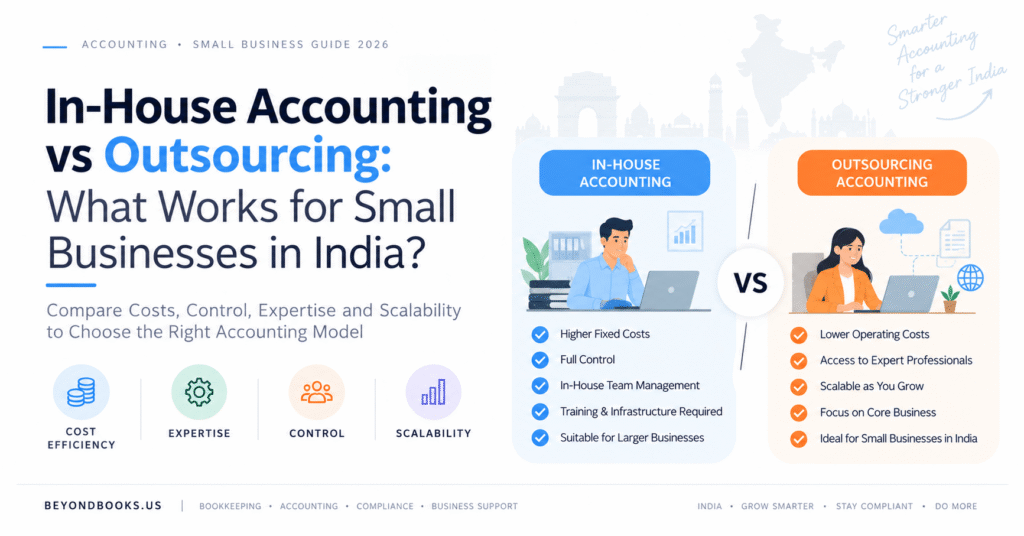
In-House Accounting vs Outsourcing: What Works for Small Businesses in India 📊 Professional Insights In-House Accounting vs Outsourcing What Works for Small Businesses in India – A Complete Guide to Making the Right Choice for Your Business 📅 Published: July 2, 2026 ✍️ By: N D Savla & Associates ⏱️ Read Time: 8 minutes Ask any small business owner in India what keeps them up at night, and somewhere on the list will be accounts. Between GST deadlines, TDS payments, invoices, and the constant worry of a tax notice, the numbers side of a business can quietly eat up hours that should go into actually running it. That brings owners to a fork in the road: should you keep accounting in-house, or hand it over to a professional to outsource? There is no single right answer, but there is a right answer for your business. This guide walks through both paths honestly, so you can decide which one fits. What In-House Accounting Really Involves In-house accounting means your business handles its own books internally. In practice, that usually looks like hiring a full-time accountant, training an existing employee, or buying software such as TallyPrime, Zoho Books or Busy and managing the entries yourself. The appeal is obvious: you get direct, day-to-day control over your financial data and someone sitting in your office who knows the business. But that control comes bundled with responsibilities, costs and compliance risk that are easy to underestimate at the start. What Outsourced Accounting Means Outsourcing means handing your bookkeeping, GST return filing, TDS compliance, ITR filing and financial reporting to a professional CA firm or accounting service. You share your documents and business details, and the firm takes care of the rest, usually through secure cloud tools. It is no longer just a big-company choice. Thousands of Indian startups and SMEs now outsource because it is more practical and far more affordable than building an internal finance team from scratch, especially in the early years. The Real Cost of Doing It In-House This is where most owners get a surprise. In-house accounting looks cheaper on paper, but the true cost adds up quickly once you count everything: Salary and overheads: A qualified accountant in India typically costs between Rs. 25,000 and Rs. 60,000 a month depending on city and experience, plus EPF, paid leave, and the cost of rehiring if they resign. Software and infrastructure: Accounting software licences, annual renewals, a computer, and backups are recurring expenses, not one-time ones. Training: Indian tax law changes constantly, GST rules, TDS rates and ITR requirements are updated often, so keeping an in-house person current is an ongoing cost. Compliance risk: If your accountant misses a GSTR-1 deadline or files an incorrect TDS return, the penalties and notices land on your business, not on them. Key Insight: The total cost of in-house accounting often exceeds the cost of outsourcing once every expense is counted—salary, benefits, software, training, and the hidden cost of compliance risk. Why Outsourcing Appeals to Indian SMEs For a growing business in Bangalore or anywhere else in India, outsourcing solves several problems at once: You pay only for what you need Most CA firms price by transaction volume and scope of work rather than a fixed salary. A small business is not paying for a full-time employee during quiet months. Compliance becomes someone else’s job A professional firm stays on top of every GST amendment, TDS rate change and income tax provision, so your GSTR-1, GSTR-3B, TDS returns and ITR filings go out on time and correctly. You still file on the government’s own systems, the GST portal and the income tax e-filing portal, but a firm ensures the numbers reaching those portals are accurate and on schedule. You get a team, not a single point of failure When you outsource, you are not dependent on one person. If someone is on leave or resigns, the firm keeps your work moving. For a small business, that continuity is worth a lot. You can start any time Even if your books are months behind or a mess, a good firm can step in, clean up the records and get you back on track. You do not have to wait for a new financial year. In-House vs Outsourcing: A Quick Comparison The table below lays the two options side by side on the factors that matter most to a small business. Factor In-House Accounting Outsourcing to a CA Firm Cost Fixed monthly salary + software + training Flexible, based on volume and scope Control Direct, on-site, real-time High, via cloud access and reports Compliance Risk Sits with your business Managed by professionals Continuity Breaks if the person leaves Team-based, uninterrupted Expertise Limited to one person’s knowledge Broad, always up to date Best For High daily transaction volume Startups and growing SMEs When In-House Accounting Is the Better Choice To be fair, in-house is genuinely the right call for some businesses. It tends to make sense when: You have a high volume of daily transactions that need constant, real-time entry. You already employ a trained, experienced accountant you trust. Your operations involve complex inventory that needs someone physically on-site. You have the budget and scale to maintain a proper finance team. If that describes you, investing in strong accounting software alongside a capable internal team is a reasonable path. The Hybrid Approach: Best of Both Worlds Many growing Indian businesses do not choose one extreme. They run a hybrid model: software like Tally or Zoho Books for daily entries and invoicing in-house, while outsourcing GST filing, TDS compliance, ITR filing and financial statements to a CA firm. This gives you real-time visibility over daily numbers and professional oversight on compliance, without the full cost of an internal finance department. It is often the sweet spot for a business that has outgrown pure DIY but is not ready for a full team. The Hybrid Model is popular because: It combines the control of in-house daily bookkeeping with the

Scroll to Top